Recently, I worked on a project where we needed to integrate a legacy Ericsson BP250 PBX with the Telekom Malaysia (TM MLS) SIP network.
Since the BP250 is a TDM-based system, direct SIP connectivity is not possible. To bridge this gap, we designed a hybrid solution using a VoIP Gateway and a FreeSWITCH system.
Architecture Overview
The integration was built using the following components:
- Ericsson BP250 (Legacy PBX – E1 interface)
- VoIP Gateway (E1 ↔ SIP conversion)
- FreeSWITCH (SIP routing & header manipulation)
- Telekom Malaysia SIP Network (TM MLS)
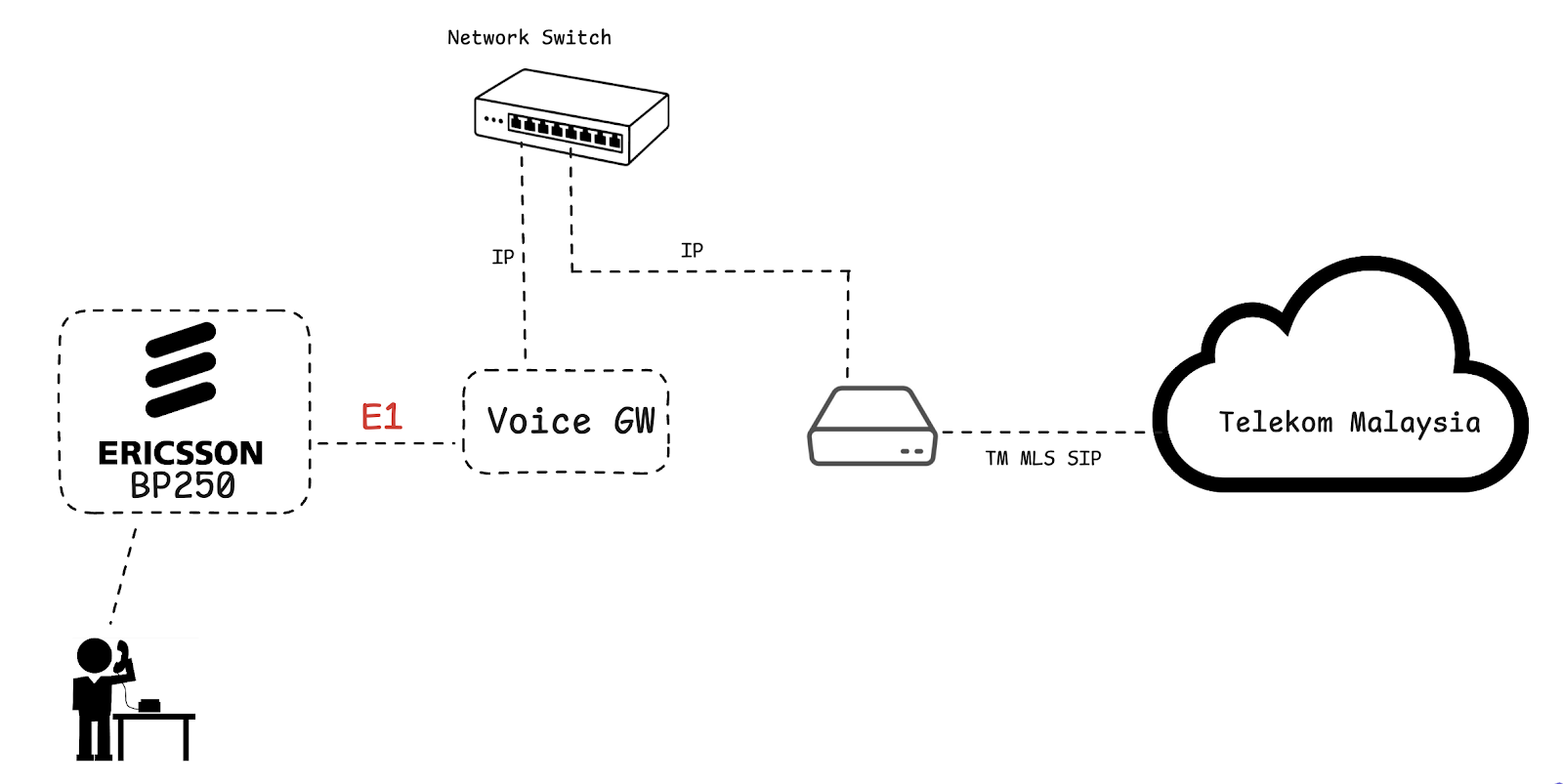
Call flow:
- BP250 connects to the VoIP Gateway via E1
- VoIP Gateway converts TDM signaling to SIP
- SIP traffic is sent to FreeSWITCH
- FreeSWITCH processes and routes calls to the TM MLS SIP network
- The reverse path is used for inbound calls
Why FreeSWITCH Was Needed
Although the VoIP Gateway can handle basic SIP conversion, it was not sufficient for this deployment.
We introduced FreeSWITCH for:
- SIP Header Manipulation
- Adjusting
From,To, andPAIheaders - Ensuring compatibility with TM MLS requirements
- Adjusting
- Routing Control
- Flexible dialplan handling for inbound/outbound calls
- Interoperability Fixes
- Normalizing signaling between legacy and modern SIP networks
This layer gave us full control over SIP behavior, which is often required in carrier integrations.
Extension Bridging (Legacy ↔ Modern)
One of the key advantages of this setup was the ability to extend the legacy PBX functionality.
We used FreeSWITCH to:
- Register new SIP extensions (softphones)
- Map them to existing Ericsson BP250 extensions
- Allow seamless communication between:
- Legacy desk phones (E1 side)
- Modern softphones (SIP side)
This effectively modernized the system without replacing the existing PBX.
Benefits of This Approach
- No need to replace the legacy Ericsson system
- Full SIP interoperability with TM MLS
- Ability to introduce modern endpoints (softphones)
- Flexible routing and header control
- Scalable architecture for future enhancements